Tuesday, April 1, 2014

Two Objects


Two Objects; one bought at an antique store in Louisville, Kentucky, and one found on the street in Milwaukee, Wisconsin, revealed by the Spring thaw. They are similar in many ways. They are of similar size and weight. Both are cast iron and heavily patinated, showing evidence of heavy use and the passage of time. In addition, both objects are mysterious to me. I do not know what they were used for. I think that the first object may have been some sort of weight. I've seen similar objects used underwater, to weight down fishing nets. Of course, it was found in the middle of Kentucky, far from any major fishing industry, but then, these objects may take convoluted routes in finding their way to the antique store. Embossed on its surface is the number "1 1/4," which I assume is a unit of measurement, although it is certainly heavier than 1 1/4 pounds. This makes me think that it may be either very old, referring to an antiquated measuring system, like 1 1/4 stone (?), or from a far away place that measures weight in something other than pounds or kilograms. For the second object, I have fewer guesses. It reminds me of the excavator teeth that were exhibited under vitrines in the recent MCA exhibit, "The Way of the Shovel." But the end that would have been the point of the tooth has a slot for mounting with a nut and bolt. I thought perhaps it could be a kind of trailer hitch, but the round end tapers in such a way that whatever it held would easily slip off. I have a small collection of these mysterious objects. It is their mystery that attracts me. In some ways I hesitate to say anything about them publicly, or post pictures of them, for fear that some reader may know what they are and fill me in, thus providing a kind of closure and stripping them of their power over me.


But there is something else on my mind regarding these objects, and it has to do with how they were acquired, and how that changes my relationship to them. In some ways, the second object feels more genuine because I found it. It is my claim. I recognized its value and its interest. By choosing to pick it up and take it home and display it on a shelf, I have personally declared it as valuable. I have difficulty taking the same kind of ownership over the first object. In this case, I have paid for the privilege of owning somebody else's discovery. The antique dealer has already curated it for me; already declared it valuable, to such a degree, in fact, that a specific price was named for it. I know exactly what it is worth, because I know how much I paid for it. I do not know the monetary value of the second object. It is likely worth very little, other than the value of the metal itself. But because I found it, rather than purchased it, I do not think of it in monetary terms the way I do the first object, and therefore its primary value is an aesthetic one. Although the value I place on the first object is also aesthetic, it remains clouded by the knowledge of the price that I paid for it, by someone else's assessment of its worth.

There is something about the antique store that seems to interrupt the natural life cycle of an object. The second object came to me through a direct series of events. The iron ore was mined, it was cast into its shape in a factory, it was attached to a piece of machinery. Years of use loosened the bolt which held it to that piece of machinery, it fell off, landing in a snow bank, it was revealed in the spring thaw, I noticed it, wondered about it, picked it up, and took it home. A similar chain of events may have brought the first object into another set of hands. That person saw a value in it, and it made its way into the dealer's hands, into the antique store. It was placed, somewhat anonymously amongst thousands of other antiquated objects thought to have potential resale value. Often these objects sit on display shelves for years before being passed along. Although the object likely had a rich and varied history up until that point, that history is rarely retained by the antique store clerk, who acts as a middle-man between the dealer and the collector. Occasionally, a piece of that history is passed along to the collector, but there are multiple opportunities for that vital information to be lost along the way, and more often than not, it is only the evidence contained within the object itself, or a general knowledge of objects of its kind, that can illuminate aspects of its past. Its specific story is lost.

I suppose a third category of object is the inherited object; one which has been handed down by a previous owner. Only then are the stories attached to the object passed along. These objects are often mythologized, symbolic objects that signify a particular view of the past, held by the object's possessor. I think of an old wooden trunk, owned by my parents, which will likely be passed down to myself or my brother one day. This is a trunk that contains stories of our lineage. I know that it came on a wooden ship from Norway with the emigration of my ancestors. I believe it was filled with lefse, a type of Norwegian flatbread, or so the story goes. Apparently it was a difficult journey and many died along the way. The details are fuzzy, but when the object is again passed down, the story will be retold along with it, and the object's particular significance will be renewed. One day, when there is no longer an heir, a kind of end will come. The trunk will be sold at an estate sale, and it will be emptied once more. Inherited objects are illuminated objects. The mysterious object; the found or purchased object, is comparatively mute. And yet, it is precisely the opacity of the mysterious object that draws me to it. Although the loss of story that accompanies each object in the antique store represents a kind of tragedy, it also leaves room for a more open kind of speculation, an imaginative impulse that is less rigid than that of the inherited object. We are no longer confined to seeking out the particulars of a specific history. Instead, history becomes a fluid, plastic medium. The mysterious object is a kind of hub with many branches and tributaries to explore. And it is in these imaginings that we begin to reveal our own orientation to the past.

Saturday, November 24, 2012

The Dance of Light


There is a certain beauty to the incidental, unconsidered cell phone picture.  Their interest lies in all of the elements that the photographer traditionally attempts to avoid, the shafts of light invading the field, the broad circles of subtle color superimposed over the subject, the irregular distortions of the outline of an illuminated light bulb, its edges separating into distinct bands of white, yellow and orange.  If we can forget, for a moment, about our accumulated standards of photography, everything we've been taught about what makes a "bad" picture, then these images become captivating studies of the phenomenon of light.  


These are quick reference shots sent by the curator of a venue that we will be showing at in Los Angeles in December.  I am so tempted to just print these 40" x 60" on fine cotton rag paper, hang them on the walls that they depict and call it a day.

Saturday, November 3, 2012

New Revisionism

"Adrian Texas. Jul 22th. 1909.  Dear friend:- I will anser your postal now Papa is going in to town so I will have to hurry. From your From your friend marion" Adressed to Miss. Mabel miller, Chatfield Ohio RR#2

I started with a bottle of white-out.  I have this idea of a perfect white plane of unknown dimensions, discovered just under the surface of the soil, as if everything above it was just an elaborate set, staged for the illusion of life. A farmer unearths it in his field. He is horrified by its incomprehensibility.

The old postcard of Panhandle Wheat seemed a good backdrop for a study along these lines. I read the back and hesitated. Can I alter this object, this piece of history, or is it too valuable? 1909. According to Wikipedia, this was the year that the Chicago, Rock Island and Gulf Railway was completed in Adrion, Texas and also the year that the American-Canadian Land and Townsite Co. began attracting prospective farmers to the area.  Probably Marion had just arrived by train to the newly established community with her family to take advantage of the nascent Texas wheat boom and she was probably writing to a friend she had just left behind back in Ohio.  The treeless expanse of the Texas Panhandle must have seemed quite a contrast to a girl growing up in the fertile midwest.

But despite, or perhaps because of its resonance, I did want to alter this object. I remembered that I had only paid two dollars for it at an antique store.  Certainly if that was all it was worth, there was no harm in changing it, even if it was a hundred and three years old.  This is how I justified it anyway, knowing that if I thought about it much further I might talk myself out of it.

I thought perhaps I should pencil out the area that I was going to paint, but the lead didn't show up well on the dark foreground, so I started searching through my drawer for a white pencil. I found one that looked to be a bit off-white, but after trying it out I realized that it was actually a sharpenable eraser. So much the better, for the eraser offered a surprising amount of control. Soon my subterranean white plane became more of a white cloud hovering just above the surface. It emerges ominously from just off camera into an otherwise clear day. Is this a foreshadow of the massive dust storms that were to devastate the panhandle in years to come? Where was Marion in 1931 when drought hit the plains and  the over-tilled earth began to blow and the "black blizzards" began? Was she still in Adrian, Texas on Black Sunday when high winds blacked out the sun removing 300 million tons of topsoil from the prairie, burying houses in giant drifts in its wake? How she must have longed then to be back in Ohio with her old friend Mabel.

Monday, September 24, 2012

Four Carriages (at rest)

I found these four photos at a favorite antique store in Minocqua, WI.
This one draws me in for the sheer distance of time.. no date, but surely quite old judging by the horse drawn carriage.  He looks to be pleading with her as she walks away with her head down. The horses wait patiently and obediently.  The pig is indifferent to the situation, content to gnaw on grass.  Is the pig traveling with them?  Is this some low point of a long journey? The photographer keeps his distance. 

A man waits in a model T(?) during a snowball fight.  The boy at the right, with the face of a bully, is more interested in having his picture taken.

1939 - Shot at midday, the man, his barn and his new vehicle emerge from whiteness.  There is no ground and no sky. They are objects in empty space.  

She has been carefully posed in the center of the square frame.  Vulnerable in the openness of this anonymous parking lot.  The white, textless rectangle painted on the building, like a thought bubble without a thought. Space-Age rocket car parked and waiting.

Monday, September 17, 2012

Wading in Flotsam


Shana and I are currently in two group shows of somewhat random composition.  One is a faculty show at the Milwaukee Institute of Art and Design, and the other is an Alumni show at the University of Wisconsin, Milwaukee.  These are difficult shows to curate, with such a disparate group of artists, each with their own thematic approach.  Any parallels must be merely incidental.  One wonders if there is some magic configuration which could possibly make such a show coherent.  If all the pieces were shuffled and rearranged a million times, would there be one sublime configuration?  Walking into Continuum (UWM), I see our piece sitting on the floor amongst a sea of disconnected artworks.  The sculpture, entitled "Hundred Year," is a meticulously crafted scale-model of a 19th century Midwestern farmhouse.  It is cut off at about halfway up the first story windows and fastened seamlessly to a low pedestal.  The effect is of a house being flooded by its pedestal.  In this context however, it seems to have lost all presence - just another business card in a show that seems to be showcasing talent more than it is communicating ideas.  It certainly didn't help that I neglected to mention to the staff that the wheels underneath its built-in pedestal were there for transport only, and were meant to be removed once the sculpture found its site.  The result is that the pedestal hovers an inch off of the ground, as if the piece was ready to take off and float away.  In and of itself, this could have been an interesting twist on the piece, but in the end, I think that it merely confuses its intent.  In retrospect, I wish that we would not have submitted this particular piece at all.  Instead I would have liked to take an approach that characterized the spirit of my thought process that I developed while attending UWM.  I should have looked at the problematic nature of the show as a challenge.  Rather than simply submitting 'something that I have made since graduating from UWM', I could have made an installation or a performance that was intended to speak to the randomness of the situation, meant to stand out amongst the cacophony, something that mischievously undermined the whole affair.  Ah well, next time.


The Faculty Show at MIAD, despite the lack of attendance at the opening, was a more pleasant experience.  Granted, the caliber of work was predictably higher, since the criteria for entry is 'art educator', which assumes an active art practice and some previous recognition for your work, rather than 'former art student,' which merely means that you graduated from college.  We submitted two works for the show.  I was pleased to walk in and see that "Burn," a piece consisting of a found hammer on a pedestal, seemed surprisingly commanding.  The hammer was found deep in the woods on my grandfather's land, where my family has held seasonal bonfires since before I can remember.  The hammer is severely pitted and rusted, to the point where the metal is changing shape.  The handle has been burnt partially off, perhaps a victim of a forgotten bonfire.  For "Burn" we simply placed the hammer on a tall, narrow pedestal and painted one side of the pedestal black to align with the burnt handle.  I consider the piece a sort of memorial to my grandfather.  The weathered hammer is an apt stand-in for Grandpa Ray, who was a rugged character who always worked with his hands.  I was always in awe of his hands, so thick and meaty, like a giant's hands, calloused and weathered from a lifetime of chopping wood.  When set down just so, the hammer's handle lifts off the surface, and the object seems to defy gravity.  For me this is the spirit exiting the body.

The second piece, "The End of the Line" is a printed photograph of our original house model (the first scale-model we built) mounted in a found frame.  The house was photographed on a frozen lake.  This was an experiment in creating the illusion of scale.  We wanted to see if we could make the model house look like a full scale house.  In the end we chose an image that held its position somewhere between artifice and illusion, with the intent that the viewer would not necessarily be convinced that it was 'real', but would rather question whether or not it was, without ready access to an answer.  In the original image, the camera was tilted, causing the horizon to appear askew.  Rather than rotate and crop the image to correct the horizon line, we simply tilted the frame.  Something strange occurred with this gesture.  It was as though the house was asserting its reality as somehow more legitimate, more concrete than our own.  The represented space trumped the physical space of our immediate surroundings.

The tilted frame has become a sort of inadvertent practical joke on the gallery staff, who are always remarking that they have to reposition the frame over and over again.  Apparently, gallery-goers cannot resist the temptation to straighten the frame, despite the well established barrier that forbids the touching of artwork on display.  I like to think of this as a kind of tug-of-war between the viewer and the viewed, each insisting on its own conflicting point of view.  

Sunday, February 26, 2012

Reclaiming Lost Histories


Yesterday I found myself scouring antique stores for old vintage postcards as part of my research for an upcoming project. I bought a few good examples, but I kept getting distracted by the old black and white photographs buried in decaying photo albums. I could feel a new collection being born. I was not drawn to the pristine, mint condition photos with proper exposure and lighting, but rather to the amateur, folk photography; imperfect and out of focus, ambiguous images that seem taken almost by accident. The decay of the photo itself interests me as well. The more faded, wrinkled and scratched the better. I'm interested in images that are disappearing. These images have long outlasted the people and events that they portray, and yet they too are temporary; an imperfect attempt at immortality.


Sunday, November 27, 2011

The Toy Store in Mount Horeb

There's a hardware store in Mount Horeb that has a small section of fine woodworking tools. Its the only time I've ever seen Two Cherries chisels at a Do-It-Best. My guess is that they are catering to all the troll carvers that don't want to drive all the way to Madison. I like to stop there when I'm passing through and buy myself a toy. This time I picked up a little Kunz spokeshave. I had to regrind and polish the chip breaker to keep it from clogging, but after this and a quick sharpening, it worked beautifully. It turned out to be the perfect tool for shaping the profile of the stick shuttles I've been working on.

Sunday, November 6, 2011

Many Hands Make Work Light

A call for volunteers surprisingly yields a Saturday crew of 5. Touching up paint, installing light fixtures and laying out the kitchen floor in the ongoing renovation of the upstairs apartment. Grilled beer brats for lunch and the mood is festive. This is how work should be done. With friends helping the drudgery fades away and the work becomes enjoyable. Bartering labor for labor, I head over to Julia and Annushka's to help rebuild the corner skirting. It feels good to be working on someone else's place for a change.

Sunday, October 23, 2011

Mahogany Shuttle

For our Iron Anniversary, I got Shana an enameled cast iron pot (because it had to be iron), but the present I was really excited about was this little pair of stick shuttles. Shana recently scored a loom, so I'm working on outfitting her with the necessary accoutrements. I wasn't exactly sure what these were for when I started making them, but a visit to Susan the master weaver set me straight. It was my first time working with mahogany and it was a dream. I tried to do as much as I could with hand tools, so I resawed and planed it by hand and shaped the arched faces with a cabinet scraper. However, the thought of cutting out the mouths with a coping saw and filing them smooth made my head hurt, so here I used a scroll saw and a spindle sander. The little oval hole with narrow saw kerf was my addition to the standard design; a place to hold the end of the thread as you start wrapping it. Next, I'll tackle the warping board.

Cold Frame Revisited

With winter approaching, it's time to reconfigure the old cold frame so we can keep fresh, late season veggies growing long past the first frost. The original design incorporated a salvaged storm window, but it was too long to face south in the new raised beds and it's paint was flaking badly. I was worried that there was lead in the paint so I decided to build a new window out of raw cedar. Note the bridal joints and through tenons. I chopped the old box down to fit the new window.

Sunday, June 26, 2011

Memories of Dreams (or Dreams of Memories)

How much can you glean from a dream that you think that you've forgotten? One that you can barely hold, just an image, perhaps a place, or a person. The plot fades, but the scene remains. What was it that happened there? Focus on the details. All specifics are only guesses. What is more real - a dream or the memory of a dream, both so ephemeral?

I am in the driveway of Grandma and Grandpa Haroldson's house in Iola. I'm with my wife, Shana. Everything is painted white - the house, the garage, the shed. The time is the present, or perhaps the future, and my grandparents have long since past, and maybe my parents as well. And now here we are, Shana and I, and we have inherited this place. We are in the driveway between the shop and the three-season room, discussing how we will use it. There is a jumbled mass in the driveway; a trailer piled and strapped together with objects like an Okie truck bound for California. We're sizing up the garage for a possible studio. This feels good, feels right. We are not upset or annoyed with the burden of the inheritance. We are happy to be there. And the nostalgia is sweet.

Remembering the dream, I ache with the knowledge of this place of my childhood being taken into foreign hands. I no longer have the right to go there, only to drive by slowly when I happen to be in town and burn with the injustice of a stranger's car in the driveway and the trim painted the wrong color, and so many flowers missing.

Wednesday, May 11, 2011

The Gardens


All work around here either comes in a whirlwind of activity or a series of small pecks that make progress excruciatingly slow. With a week and a half off between the end of school and the beginning of our artists' residency in Utah, we've seized the opportunity to dive headlong into the landscaping, and the results have been fruitful. We are watching the weather closely and tomorrow we will decide whether to have a truckload of dirt delivered before we go. But rain looks likely, so we'll see.


Working around industrial design students for the past few years has made me see every problem as a design problem to be weighed out equally in terms of aesthetics and utility. As a result, our new compost bin is a marked improvement for the one at our last house. It was made from repurposed cedar spindles from a carpentry job that, due to a calculation error, yielded a couple hundred extra (it was a big job). This composter features removable front slats that individually slide out to allow access to the compost.


Gathering stones on mother's day from the pile up at the 20 acres in Iola, where my father is engaged in a massive landscaping project of his own. He is "weeding" the woods, attempting to eradicate them of two invasive species; buckthorn and bayberry(?). Its a daunting task, as these two species seem to make up about 80% of the underbrush. Looking around, the task seems almost futile, but we walked through the woods where he had cleared large areas and the progress was quite impressive. He hopes to reintroduce native species that will compete and hopefully keep the invasives at bay. Its interesting to see my father following in my grandfather's footsteps, spending his days up in the same woods. For grandpa it was chopping wood, planting trees, driving the tractor, and sipping on blackberry brandy. For dad it is clearing trails, planting more trees and planning the construction of a cabin/workshop which may begin to take shape this summer. Back at home I'm on knees trying to eradicate the ever-invasive dandelion, one by one because I refuse to use chemicals.


After a year, a housewarming gift from my parents finally sees soil. Three new trees have been planted along the south side of the house; a redbud in the front yard and two apples; a Courtland and a Jonathan, in the side yard. The drainage was not what we had hoped in the side yard, so we may have trouble with the apple trees, but we mounded them up and buried gravel underneath them and now we will keep our fingers crossed and hope that there is pie in our future.


Raised bed of white oak 2x10's with Greene and Greene inspired joinery.

Friday, April 29, 2011

testing


Hello? Is anybody out there? Whats this? Could it be? The Sun!

Friday, January 7, 2011


'What of miniature boats constructed of birch bark and fallen leaves, launched onto cold water clear as air? How many fleets were pushed out toward the middles of ponds or sent down autumn brooks, holding treasures of acorns, or black feathers or a puzzled mantis? Let those grassy crafts be listed alongside the iron hulls that cleave the sea, for they are all improvisations built from the daydreams of men, and all will perish, whether from ocean siege or October breeze.'
- Paul Harding


Saturday, July 3, 2010

Sweet Sabotage


Normally on Fridays, Shana and I meet with our intern, Calvin, at the studio. We set up this internship when we had planned to do a major hanging sculpture for the Overture Center in Madison. But scheduling conflicts meant that the sculpture would have had to be installed right around the time when we would be moving in to the house. And the approval process took longer than expected, pushing back our start date to the point where the window of time for fabrication was getting frighteningly narrow. Renovating the house and building this sculpture simultaneously would have been a recipe for a complete nervous breakdown. Something had to go, and the paperwork on the house was already signed, so we postponed the Overture project for a later date. But we kept the internship anyway, figuring that it would keep us from being completely absorbed in the house project and neglecting our art career. As I am seeing the renovation partially as research for our artwork, the internship allows us to maintain a running thread of continuity with our previous work and keep the renovation relevant to our art practice. The installation for the Overture Center, incidentally, depicted an old farmhouse with its bottom falling out. The sculpture we are currently building with our intern is the same house presented as a sculpture being flooded by its pedestal. I promise to get further into the content of these works and their relationship to the renovation in future posts.

After reading my last, somewhat pathetic blog post, Shana in her infinite wisdom decided that a bit of triage was in order and she hatched a plan to kidnap me and force me to take a break. Unbeknownst to me, she called up the intern and cancelled our Friday meeting. She decided that she would put the bikes in the van and on our way to the studio she'd just keep driving and we'd head up to the northern Kettle Moraine for a day of biking, swimming and hiking. But when I threatened to go to the house early to get some mudding done before we met with Calvin, she was forced to spill the beans. Fortunately, I did not protest and despite a hiccup with a broken inner tube valve which put an end to the biking plans, we spent a much needed leisurely day swimming and hiking at Mauthe Lake.


On returning to Milwaukee, we paid a visit to Maurice Grimes, one of the sage woodworkers in my life. He treated us to Shrimp and Asparagus pasta and made sure our glass was always full. Seeing the lush gardens, collections and endless woodworking projects that engulf his 1872 brick house brings his character together. This is a man who has truly made his home an extension of himself.


Today I go back to work, and despite a bit of a sunburn, I'm not feeling the burnout... I'm ready to get back into it. It helps also that we've reached a turning point in the project. All of the internal stuff is done... the plumbing, the electric and the insulation... which means we are hanging drywall. The destruction phase is over. Its time to begin putting this house back together again. And this feels good.

Tuesday, June 29, 2010

The Anatomy of the Wall


To ask somebody to work 12 hours a day, seven days a week, with breaks only for meals and sleep, brings to mind words like cruel and inhumane. I would never ask anyone to do this for me, and yet here I am working this schedule voluntarily. I suppose the difference is that I am working for myself, rather than toiling away for someone else's profit with no direct, tangible rewards other than the abstract notion of a paycheck. I will live with the results of my labor and eventually, the hope is that it will all be worth it. But there is no escaping the inevitable physical and psychological effects of working such a schedule. Eventually it catches up to you. I was at a family reunion this weekend, one of the first Sundays this summer that I have not spent working on the house. My aunt Lynn was recalling her experience of building a house and she described an image she had of the house going up while she crumbled to the ground. More than I'm happy to admit, I can relate.

When I set out to make this blog, I decided that I didn't want to treat it as a diary. I didn't want it to be a blog that put my heart on my sleeve for everyone and their mother (and mine) to hear about. I had read a few blogs that seemed like calls for attention, cries for help, and this is exactly what I wanted to try to avoid. I guess I envisioned this sort of romanticized notion of renovation as an intellectual exercise and I would use the blog to report all of the insights and inspiration I had gained through the process. You may have noticed that I have not posted in quite some time. This is because I hit a wall. There were too many posts, to many things that I wanted to write about and not enough time. Meanwhile the romance of the project was fading and being overshadowed by the immensity of the workload. And this wall is reinforced with events that don't fit my romantic notion of what the renovation should be; events like when I was pruning the neighbor's maple tree that was crowding out our cedars. It was shaping up to be a great blog post as I was climbing on top of the garage roof and it just happened to be the day of the air show and the Blue Angels were flying overhead. But when I cut the wrong branch and it came crashing down, taking out all of the limbs on one side of the cedar, it took the wind out of my sails. I loved that cedar. It had such a nice shape. It was one of the reasons why I wanted this house. Now it's lopsided and awkward and the pruner is retired to the garage. Meanwhile, streams of water continuously seep into the basement all along one side of the house. It's proving to be a much worse problem than the seller had made it out to be. All the while the move in date creeps closer and closer and I'm not sure that I can outrun it.


Once a week or so I try to take a little break. Going to Iola for the family reunion felt like my first true taste of summer... what people are supposed to do in summer; hang out, drink a few beers, enjoy the weather. Two weeks ago Shana and I went for a morning hike. This morning we went swimming and I stopped at the house and picked the black raspberries growing behind the garage. I keep waiting for these little breaks to fill me up and reenergize me, so that I can go back to work with renewed vigor and enthusiasm. But mostly, I'm just tired and anxious. What I really need is a week off, but I know I can't have it... not yet. Shana and I have scheduled a trip up to Madaline Island on Lake Superior for the week after we are supposed to move in. It will be a well deserved vacation, but depending on our progress, we may or may not be able to go. It's good incentive to keep pushing forward, but theres a limit to how much we can accomplish in a given period of time. We'll see.


Maybe what I am going through is something akin to the renovation itself. Something that necessarily begins with destruction, with violence, but clears the way for something improved, something stronger - a phoenix. But this phoenix has an attraction to the fire, and I wonder how many times it can be reborn. Sometimes I think that what we are doing here is absurd. All of our decisions about the house are these attempts to make a place that is comfortable, relaxing, a place of leisure. When the renovation is done, I tell myself, then I can relax and enjoy the fruits of my labor. But the reality is that when the renovation is done, I will dive headlong into the next big project. I can sit in my Morris chair, on my oriental rug, in front of my fireplace in the restored bungalow that I've always wanted, but will I really be able to appreciate it or will I be too deep in the anxiety of the next deadline? Dear reader, my heart is on my sleeve now, and I'm sorry you have to hear all of this, but the the fact is that the blog has stagnated because I have been dishonest... I've been holding back, and a true look at this project must acknowledge the fact that pain and suffering are two of its componets, and they are perhaps the price that must be paid for the fulfillment that will come with its completion.

Monday, May 31, 2010

Tapping the Reserves

As we get deep into the work of the house, the days are long and we're maxing out our energy reserves, getting up early and working until we can't work anymore. The blog becomes another item on the to do list, buried under rows of more urgent tasks. Coming back from L.A. I had hoped to spend a day or two decompressing and reflecting on our trip before diving back into the construction zone, but a call from Evan said that he and Hyo Jung were ready to come up and help finish the electric work, so we were right back in the thick of it. Now, on this Memorial Day, while the rest of the world is out camping, I've decided to go out for breakfast and start on the house a bit later. I'm peering across the street at the lumberyard trying to figure out whether or not they intend to take the day off. Somewhere there's a holiday bucket of drywall mud for me, even if it means going to the Dumb Hippo (that's code for Home Depot). I have a long post I want to write about L.A., and maybe I'll still get to it. But for now, here's a few pictures:

Shana with Cousin Jeff, who was our Pasadena host, on the back porch of the Gamble House

This picture basically sums up Mark and Shana's friendship

Hiding in the bougainvillea at the Schindler House

Mark in his Hollywood apartment giving his best bad guy look

A rare look at the bones of a perfect house surrounded by other perfect houses in a perfect neighborhood.

My dust mask awaits.

Tuesday, May 18, 2010

Pepperoni and Other Building Materials


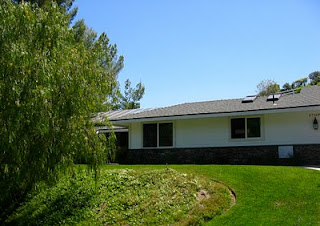
The old house. The house that I grew up in - from age 5 to 14 - grade school to Jr. High. Everyone said that when I visited Canyon Country I would be astonished by how much it has been developed, but to me it didn't really seem like it had changed much. Sure there were some new houses, but the place was under development when I was living there and what I saw just seemed like a logical continuation of that process. There is a limit to the development possibilities in our old neighborhood because eventually you run into steep canyon walls that are essentially unbuildable. And over the hill in Crystal Springs, the roads had expanded to reach these natural limits. But in my immediate neighborhood, on my street, there were the same number of houses that were there when I lived there. Most had changed little. Our house, so I heard, had undergone a million dollar renovation. I was expecting to see an unrecognizable monstrosity, but really they had only added a small addition over the concrete patio where we used to hang the laundry. Other than that, the footprint was essentially the same. She had however undergone a major facelift. The pergola had been removed, it was painted white, and there was an apron of brick up to about waist height that ran around the perimeter of the house. Even with all of these changes, I stood for a moment nearly dumbstruck by the sight of the place. It seemed to vibrate with an intense energy of compressed memory. It was a sort of feeling of vertigo, a tingling in the chest. The owner was in the driveway, tending to his trailered speedboat, so we approached and introduced ourselves. He was kind enough to let us into the back yard and we reminisced about the history of the place. I looked up at the back hill and I remembered that I once buried a cat up there, where there was now a white vinyl fence. Apparently he had dug up a box while setting posts, but he assured me that he reburied it once he realized what it was. Seeing the backyard, my heart sank. The wonderland of trees and cacti that I knew as a child had been nearly stripped bare. What motivated them to cut down such glorious trees I can only guess, but he mentioned something about maintenance. I remember having to sweep the pool of pine needles, but this hassle never would have led me to the conclusion to cut them down. And probably the plum tree, and the pear tree, and the apricot tree were removed because of their "litter" as well.


Several years ago, when I first drove by my grandparents' house in Iola, Wisconsin after it was sold, and saw that they had painted it beige, I felt violated, like they had tampered with something sacred and gotten it all wrong. I wanted to go inside and tell the new owners that the house was supposed to be red, that they should put it back the way it was. It was enough that my grandfather had removed the light-up Haroldson Electric sign from out front when I was in grade school. It made no sense to me that it was no longer needed because he had retired. It was simply supposed to be there. I wanted it back. And now some stranger thinks that he can go and paint the house any color he wants, just because he bought the place. This was the house that my grandparents had bought with another relative and then split in half because they could not afford the whole thing. They literally cut it in half and had their side moved to the site. They lived in a renovated chicken coop on the property before they could afford to have the house brought in. And this was the place that I had gone every summer of my childhood from the time I was a toddler and built up a treasure trove of sweet memories. All of those memories are housed. They belong to that place. I can crawl up the carpeted stairs in my mind and I can tell you what is in each drawer of the dresser at the landing between the two upstairs bedrooms. I can see in intimate detail the star patterned holes in the acoustic tile ceiling, the light up painting hanging on the wall, and the plastic flower arrangements in the corner. I can see my grandpa fiddling with the receiver on his satellite TV and I can feel the texture of the rainbow striped carpet in the three season room. And when we bought the bungalow and I stepped into my very own garage, I smelled the odor of the gas lawnmower and grass clippings and instantly I was transported to Grandpa Leo's shop in his garage where we would search through innumerable tiny drawers of parts for things we did not understand and there would always be a Jolly Good Cola in the fridge. For a hundred some thousand dollars, my family relinquished all rights to this place and our memories are buried, one by one, under layers of paint and new carpet. Of course there would have been no sense in keeping it. There would have been no one to live there. But it is painful nonetheless.

I came to Canyon Country bracing myself for this sense of loss. But when I first set eyes on the place and felt that rush of energy, I knew that somehow its essence remained. And I drove through Canyon Country on instinct, searching out places that gave me that sense of warm nostalgia. I found it in the hill in front of my house that I used to skateboard down, and I found it in the old green utility box on the side of the road that served as our bus stop. It has often been noted that nothing can trigger memory like a smell or a taste, and I knew that the nostalgia jackpot was waiting for me in the crispy pepperoni on top of a Round Table pizza, a taste that I have been craving for twenty years. We pulled into the strip mall and there it was, where it had always been. I walked in and instinctively ordered a root beer. I took one bite of pizza and I knew, and was comforted that some things never change. Looking around the room, I saw that they had remodeled a bit, but the arcade was still there, and the same coat of arms, although it had been moved, was still hanging on the wall. It struck me that the world is a palimpsest, alternately being covered and revealed in layers, reconfigured, rearranged, but never really fundamentally changed. Space remains where it is, and seems to contain all that was ever there.


Before we returned to LA, we stopped at Vazquez Rocks, where my parents had taken us on a yearly excursion for Easter sunrise service. It is also the place where many films have been shot, usually portrayed as an alien landscape. Climbing on the rocks Shana turned to me and remarked, "Being here, I think I understand you a little better," because it is after all, a part of me.


Monday, May 17, 2010

Bungalows Galore


Up to Mulholland Drive to gawk at the Beverly Hills mansions but to no avail. We drove into the clouds and saw nothing but gray. But down on the flats we saw many exquisite bungalows throughout the city. Here are a few of the gems.


"Love has conceived a house,
and out of its labor
brought forth its likeness
-the emblem of desire, continuing
though the flesh falls away."

-Wendell Berry

Sunday, May 16, 2010

Arriving in L.A.

"...the house we were born in is physically inscribed in us. It is a group of organic habits. After twenty years, in spite of all the other anonymous stairways; we would recapture the reflexes of the 'first stairway,' we would not stumble on that rather high step. The house's entire being would open up, faithful to our own being. We would push the door that creaks with the same gesture, we would find our way in the dark to the distant attic. The feel of the tiniest latch has remained in our hands." Gaston Bachelard - The Poetics of Space

And it has been twenty years since I've been to Los Angeles. Shana and I are here to give an artist talk and scope out venues to develop a future project. But for me this is also a journey into the past. Today we will drive to Canyon Country, where I spent eight of my most formative years. I hear that our house has undergone a million dollar renovation, and that the suburb is much more densely populated. I go there in search of memories, but I know that the landscape will be very much altered. I hope to find some things that have not changed. The transition had already begun when I lived there. We had a hill in our back yard that we would climb up to the top and watch the landscape being inscribed with twisting mountain roads lined with innumerable houses. Everywhere the hills were being reconfigured by bulldozers, and these became our playgrounds. We would ride down the plateaus with our BMX bikes, steal lumber from job sites to build skateboard ramps and explore the drainage tunnels that went below the new roads. I know that what I will find is a very different place. But the train bridge where I dodged a train after egging cars in the middle of the night with Eric Close, buzzed on my first sips of alcohol, will still be there. The hill where we made makeshift snowboards out of skateboard decks and bike tires for bindings the one time it snowed will still be there. And maybe, maybe some of my neighbors will still be there. Maybe I will vaguely recognize a face or two, transformed, like mine, by twenty years of a different life.


Upon arriving in LA, the first thing that draws my attention is the foliage. Even though I grew up here, the palm trees and cactuses seem so foreign and exotic. It feels like another country. Then come the place names; Marina Del Rey, La Brea, Malibu. They are so musical and romantic. I remember reading these names on the freeway signs as a child and dreaming of these places. Some I visited and some I did not, but they all exuded a feeling of great leisure. And as I walk through the streets of Los Angeles, I feel that old slow step coming back, and my speech begins to become a little bit more drawn out. In Wisconsin, we are always in a hurry, because we know that even in the middle of summer, the bitter cold is right around the corner. Here summer lasts forever, and there's nowhere to go, because you are already there.


Sara Daleiden, our host and an old friend from Milwaukee, has put us up in fabulous penthouse designed by Viennese architect Rudolf Schindler. Schindler came to California on a job building furniture for some of Frank Lloyd Wright's California commissions, but soon established his own practice. He built the first examples of international style architecture in California, planting the seeds for the playful explorations of modernism that are so characteristic of the Los Angeles architectural landscape.


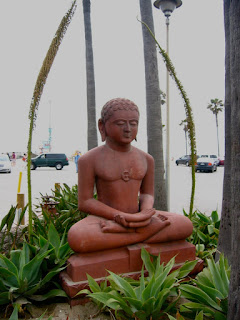
After settling in, we had a bit of free time so we drove down to Venice Beach, where I went many times as a child. Here's a quick photo tour:

Greeted by the Buddha

We ran across a classic beach house designed by the Greene Brothers. Later in the trip we will visit the Gamble House. (Correction; this house was built in the style of Greene and Greene, but by a different architect)


Some calisthenics at muscle beach


Reminders of home.